THE BRIGHTNESS OF GRAY
Chapter 3: The Melody of the Rubble
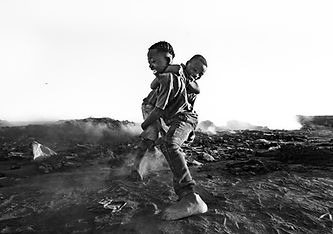
Amid the smoldering mounds of an endless landfill, where the air carries the weight of abandonment and the sky hides behind heavy gray clouds, life stubbornly refuses to fall silent. This desolate landscape is both the birthplace and the only world these children have ever known. There are no screens, televisions, or modern sound systems here to dictate the rhythm of the days. No illuminated stages or pristine music that cradles childhood in other corners of the world. Yet, against all the harshness of the scenery, the silence of misery is broken by a purely human force.
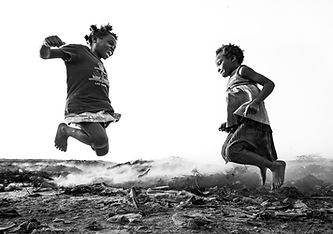
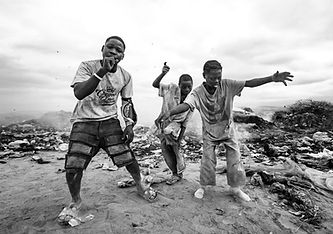
In this chapter, the music is born from nothing—or rather, it is born from within. Keto, an older brother, who shares the same destiny, the same ground, and the same worn, soiled clothes, becomes the maestro of this improbable playground. Cupping his hands to simulate an imaginary microphone, he unleashes his voice. He sings Kuduro, the vibrant rap born from the streets of Angola, improvising verses that echo through the debris. His voice is the only available instrument, yet it carries the pulse of an entire community.
Around him, the miracle repeats itself. Hearing nothing but their friend's raw melody, the children burst into dance, jumping and leaping. Their faces light up with wide, open, and genuine smiles, in a celebration that defies the toxic smoke in the background. They do not need technology to find the rhythm; the voice of the one walking beside them is more than enough to ignite their joy.
These images capture the triumph of sharing and ingenuity over scarcity. Without artifice or possessions, these children prove that true fun cannot be bought—it is invented. As they dance barefoot on the dusty earth, guided solely by an improvised chant, they transform desolation into a poetic manifesto of freedom. In the absence of everything, their music is their own body, and their stage is life itself.


Chapter 2: The Magic of the Wheel
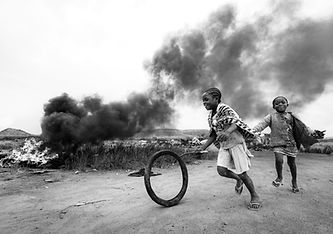
Under the same dull sky that shapes the landfill where they were born and raised, movement defies the stillness of despair. For these children, whose only known horizon is a labyrinth of waste, the world gains a new velocity when the oldest secret of humanity is uncovered. There are no gleaming bicycles here, no pedal cars, or electronic circuits. There is only the landfill, vast and gray. And yet, a magnetic force is born when debris ceases to be refuse and becomes motion.
In this scene, we witness the awakening of an ancestral fascination: the magic of the wheel. Armed with worn sticks, bare feet dug into the firm ground, and clothes carrying the patina of labor and time, these children run side by side with perfect circles of rubber and metal. An old motorcycle tire, a warped bicycle rim, a broken plastic toy with its wheels still intact—everything discarded by the world of adults gains a second, noble life in the hands of childhood.
The wheel exerts an almost mystical attraction over them. It represents perpetual motion, the promise that one can go further, even when their legs are tied to the same barren soil. As they push these treasures rescued from the mounds of garbage, their faces light up with an open, disarming laughter. The wheel spins, and with it, imagination spins too. The toy does not arrive in a perfect box; it is discovered, cleaned, and baptized by the ingenuity of those who have nothing, yet invent everything.
These black-and-white images celebrate the victory of simplicity. Without the artifice of consumerism, these children prove that play does not reside in the object itself, but in the spirit of the one who guides it. As they roll metal and rubber through the dust, they are not merely pushing the world's garbage—they are spinning their own joy, transforming a landscape of abandonment into a playground of pure freedom.


Chapter 1: Flying Over the Earth
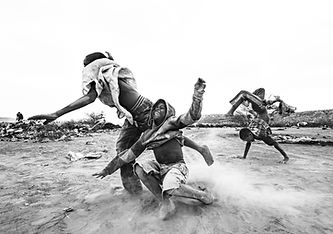
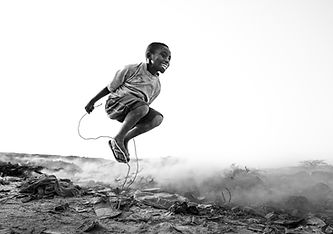
In the depths of a dry and dusty plain, where the horizon is shaped by mountains of debris and neglect, the ground does not usually promise gentleness. It was there, in that barren landscape that frames the only world they have ever known, that I saw gravity bow before purity. Three children, whose bare feet carry the texture of the solid earth and whose worn clothes bear the marks of a harsh routine, run toward nothingness. Or perhaps they run toward everything.
In this short story, the precise moment when misery loses its mechanical weight is captured. Without the artifice of sophisticated toys, flashing screens, or the plastic colors of modern childhood, they possess only their own bodies and an unyielding imagination. When they launch themselves into the air, in a perfect somersault that defies the harshness of the ground, time stands still. There is no garbage in the background; there is only flight.
As they land in the dust, laughter erupts, free and disarming. Each fall is celebrated with a genuine giggle that echoes through the silence of the landfill, while a small cloud of dust rises from the ground, as if the earth itself were applauding their audacity. It is a joy stripped of possessions, a triumph of the human spirit over the gray landscape that surrounds them.
This short series do not seek to romanticize poverty, but rather to document a daily miracle: the timeless instinct to play. In the absence of everything, these children reinvent happiness from the very ground they walk on, proving that dignity and smiles refuse to be buried by any waste.