THE BRIGHTNESS OF GRAY
Chapter 4: Wings of Dust
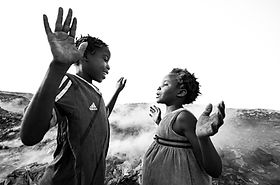
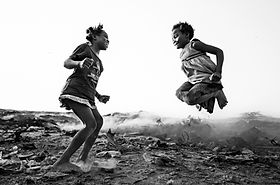
Beneath an opaque sky that fuses with the white smoke of the landfill, two children prove that joy cannot be bought—it is invented. Barefoot, in worn clothes and without a single toy in their hands, they need only each other to transform the monotony of the plain.
Face to face, they clap their hands, tuck one leg, and launch themselves into a dusty leap, as high as they can. For a brief moment, with their legs tucked in the air, they seem to hover above the misery, free from any bond.
Their wide smiles break through the toxic haze. With the power of a shared bond and the rhythm of their hands, these children flood the gray with an unexpected light of freedom.






Wings of Dust
Beneath a heavy, opaque white sky that fuses into an invisible line with the perennial smoke of the waste mounds, the landfill plain seems suspended in time. This ground, littered with the debris and scraps of an outside world, is the only cradle these children know. Born in the heart of oblivion, they have never seen any landscape other than this monotonous, gray horizon. They wear worn clothes, steeped in the patina of labor and dust, and their barefoot touch directly meets the raw cruelty of the earth.
Yet, where scarcity would dictate silence, childhood imposes its own rhythm. It is within this invisible resistance that the essence of the project "The Brightness of Gray" reveals itself, where human dignity manifests in the purest state of survival: play. Here, unlike in other settings, not even the fragments of broken toys rescued from the fires are needed. For the miracle of joy to happen, the meeting of two souls is enough.
Standing face to face, the two children shed the gravity of the environment that surrounds them. The ritual is of an ancestral simplicity. They challenge each other with their eyes, clapping their hands in a shared rhythm while tucking one leg, and, in a sudden surge of pure energy, launch themselves toward the sky. They leap as high as they can, with both legs tucked in the air, as if for a brief moment they could hover above the misery, free from any earthly bond.
Their faces, lit up by wide, deeply genuine smiles, break through the toxic haze of the scenery. They prove that the capacity to play does not reside in possession, but in the marvelous ability to invent the world from nothing. In the end, when their feet return to the dusty ground, what endures is not the weight of the rubble. It is the echoes of those unpretentious claps and the crystalline sound of their laughter which, like a sacred melody, manage to flood the sad plain, transforming the gray of the landfill into a stage of light and unexpected freedom.


